|
|
Welcome back to A Closer Read, Harper’s Bazaar’s seasonal books newsletter. This fall, we’ll be covering the most exciting new books, interviewing some of our favorite writers, and exploring titles you may have overlooked.
|
|
|
|
Welcome back to A Closer Read, Harper’s Bazaar’s seasonal books newsletter. This fall, we’ll be covering the most exciting new books, interviewing some of our favorite writers, and exploring titles you may have overlooked.
|
|
|
|
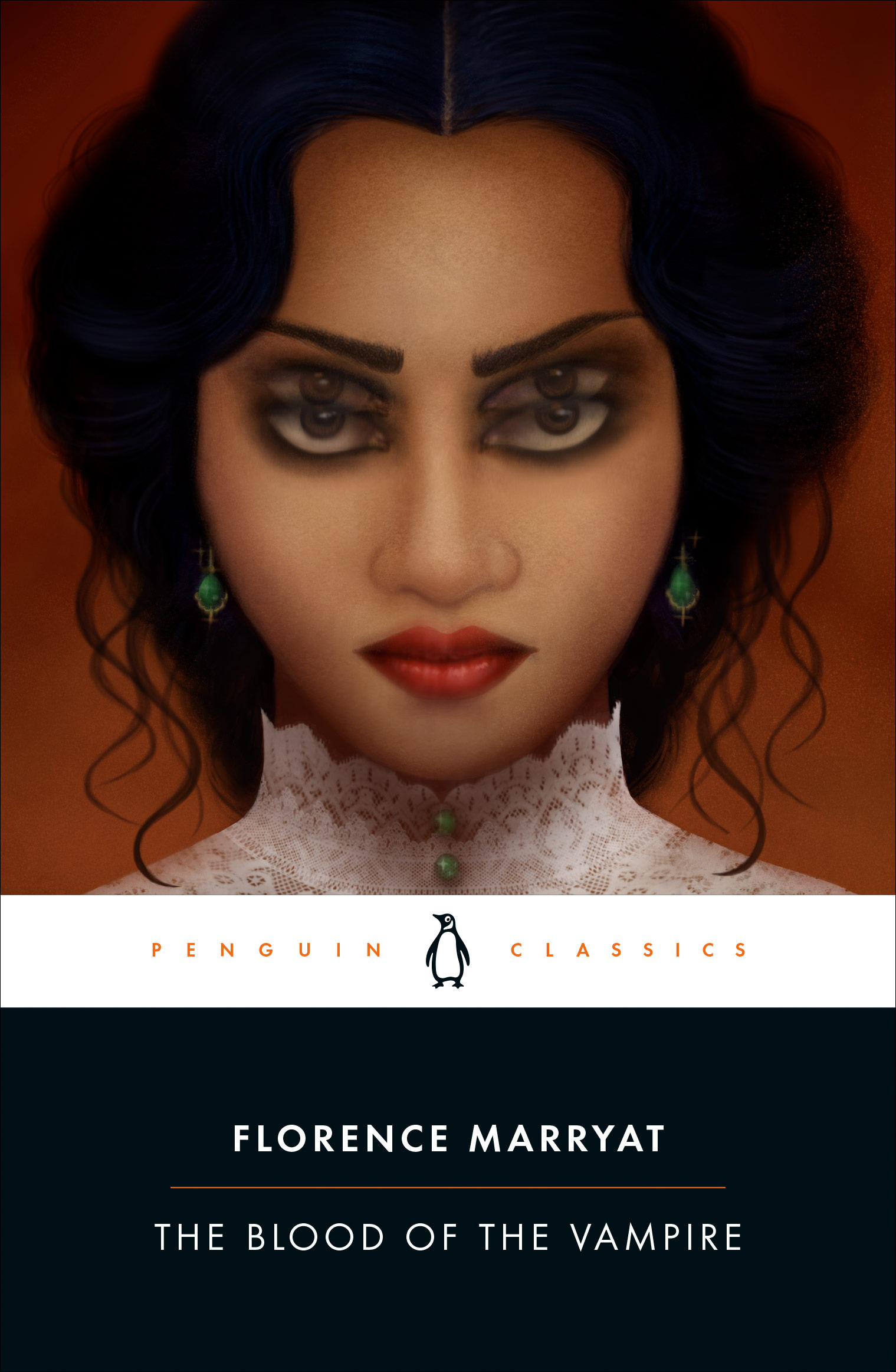
A few weeks ago, I saw a post from the publishing imprint Penguin Classics about a reissue of a “lost” 19th-century vampire novel, The Blood of the Vampire. The description included this detail: “a bisexual, biracial vampire stalks London”—and that alone meant I knew I had to read it. The Blood of the Vampire, written by Florence Marryat, had the bad luck of being published the same year as Bram Stoker’s Dracula, 1897, and was often compared to it. The Blood of the Vampire was considered part of “a wave of imitations by inferior writers,” and critics objected to its mixed-race protagonist, arguing that focusing on this type of character was overly sensational. It’s a strange critique of a vampire story that suggests the contemporary culture’s anxieties around race and Blackness more than anything else. The Blood of the Vampire now reads like it was written today. Harriet Brandt, the vampire in question, is a young heiress who had lived in a convent in Jamaica until just before the novel starts. She meets two British women at a resort in Belgium. Harriet is clingy and cloying, and one of the women chalks it up to her not being used to socializing. Her background is mysterious; she claims to be the daughter of a white governor and a white woman of unclear origin. In conversation, Harriet is chronically incapable of hiding the ugliness of white rule in colonial Jamaica. As soon as she meets the two Englishwomen, she starts bragging about how much she loved beating the Black servants on her estate. When she sees one of the women’s children, she can’t help exclaiming, “I love little white babies!” to the alarm of both women. The irony here is that the two women are themselves the wife and fiancée of colonial agents of the British Empire, one of whom is serving in India. Both men are connected to, if not directly engaging in, the race-based violence of the empire that Harriet delights in, though the women find Harriet’s frankness about it all gauche and off-putting. Harriet’s true identity is slowly revealed over the course of the novel, even as she seems to suck the energy of the women around her with her outsize feelings. Harriet is at first unaware of her vampirism. She experiences it more as an illness or genetic defect rather than a desire for blood or violence. Her vampirism is more insidious, a difference that keeps her from forming the deep emotional connections she desperately wants with the women around her. Anyone she gets close to sickens and dies. The book includes a subplot built around medical racism, and Harriet falls in with a socialist boyfriend who insists the problems of the world are based on class, not race. If you cannot tell from all of these details, the book has a campy, winking quality that has to have been intentional and makes it even more fun to read. A vampire novel about anti-Blackness and the toxic side of female friendship feels tailor-made for this moment. The Blood of the Vampire may have finally found its place in vampire lore.
|
|
|
|
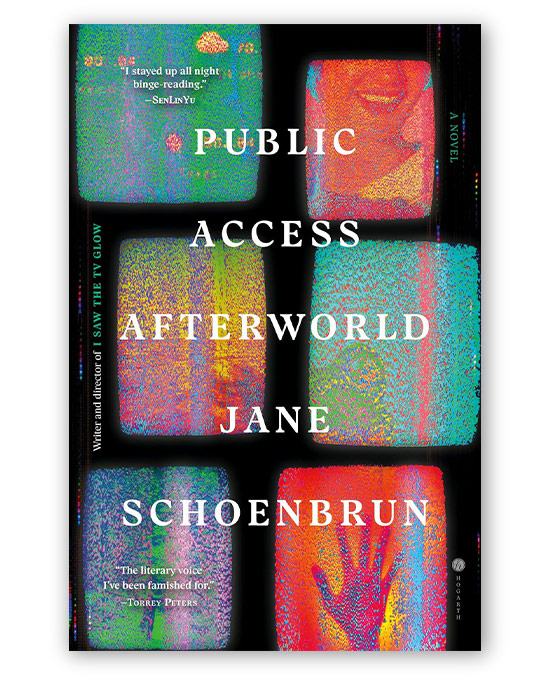
Jane Schoenbrun is one of the few directors working today who can engineer an image you have never seen before. With wholly original films like We’re All Going to the World’s Fair, I Saw the TV Glow, and Teenage Sex and Death at Camp Miasma, Schoenbrun makes movies for an audience multiple prefixes past post-post-modern. In Schoenbrun’s films, the screen is a place where people lose and find themselves, over and over, in an infinite loop of identities and emotions. Their debut novel, Public Access Afterworld, takes that premise and blows it wide open, tracking a vast conspiracy involving atomic testing, internet message boards, and one intrepid content moderator, Bethany, who is destined to save the day. The first book in a planned trilogy, Public Access Afterworld reads like an updated version of Good Omens or the Terry Pratchett Discworld novels—big epics of the everyday and the magical, slashed through with deep questions about existence and the nature of self. For this newsletter, I spoke with Schoenbrun over Zoom about learning to write a novel after teaching themselves how to direct films and the pleasures and pains of nostalgia.
The idea for your novel started as a TV show, correct? You wrote a pilot and show bible but changed course when it became clear it would be difficult to finance. Can you talk about changing creative direction and how you keep going in the face of initial setbacks?
It started actually as about 1,600 pages of TV scripts that I wrote without anyone asking me to, which—if you want to get a TV show made, the best advice I can give you is not to do that. People definitely don’t want you to come being like, “Yeah, here’s the show. It’ll cost a couple hundred million dollars to make, and I’ve written and planned out the entire series, basically. Here you go.”
I kind of knew that while I was writing, but this was something that I had been doing since childhood, which was making up TV shows in my brain. And so much of the joy was getting to tell stories on that size of canvas, tell stories with characters that can change over seasons and episodes. And, yeah, when you’re making the kinds of movies with the kinds of budgets that I do, it’s just totally impossible to have that canvas size.
Once I became really attached to [the world of the novel] and the mythology and these characters, it just became my worst nightmare that they would never see the light of day. I kind of knew I was going to have to write it as a book … and I knew I was going to have to teach myself that medium.
I taught myself filmmaking in many ways. I spent several years before I made my first film just watching obsessively and studying and trying to understand the questions that I didn’t know yet to ask.… Teaching myself to write this novel was a very similar process. The hardest part was those first six months where I was just rewriting the first 40 pages over and over again, not happy with the way that it was coming out because it didn’t match the way it was in my head.
But then, because I had experienced all of that before with film, I could kind of draw parallels between the process of, like, Oh yeah, it’s not that I’m bad at this, it’s just that I’m new at this. I just started reading a ton and returning to my favorite authors to see how they did this thing that I didn’t quite know how to do yet.
|
|
|
|
I kind of KNEW I was going to
have to write it as a BOOK …
and I knew I was going to have to
TEACH MYSELF that MEDIUM. |
|
|
|
What were some of the things you were reading?
Honestly, it was something different for each section of the book, because the book is this strange mix of a lot of fantasy, sci-fi, dreamlike stuff. But then there’s also a lot that’s very grounded in the novel, and that’s trying to be maybe more gentle or sensitive or emotional … than most epic fantasy tales. At times I was reading a lot of James Baldwin. At times I was reading a lot of Haruki Murakami. At times I was reading really bad contemporary popular books that I didn’t like much but that I thought I could learn something about how to hook people in…. Really, just asking myself the question of, Okay, if I want to train myself to speak eloquently in the way that I know my favorite authors can do, who do I turn to for that?
This novel has an expansive cast of characters of different ages. Can you talk about inhabiting characters in very different stages of life?
It’s so fun and something that you can do a little bit in film. You can change your language in filmmaking to match the inner world of a character. If a character is really paranoid, the filmmaking can feel jittery and stuff, but it’s different. It’s different when you have the tool of prose and can write, even if you’re not writing in the first person. This book kind of jumps between. Certain sections are first person, and some are third; my personal favorite is second person.… I found it such a beautiful way to get at something kind of scary and sad about reality. And then there is an overall voice; there’s my voice that is carrying between all of it.
It’s like a shape-shifting thing, and it’s almost like a performance. When the World War II section of the book starts, I was reading a ton of 1940s books and really trying to subtly mimic a different style of writing there. When we’re with the character of Jules, who’s a stoner kid who’s probably finished half of high school, they’re just articulating themselves in a very different way than Bethany is. If you learn to really embrace those gaps and love them, they don’t become a thing that makes it more confusing. They actually can help to illuminate the reality of what’s going on. It’s this kind of Rashomon structure where we’re seeing everyone through everyone else’s eyes.
It also becomes a storytelling device in what you withhold and what you don’t withhold. There are twists that happen in the book that open up new narrating perspectives that we couldn’t have gotten to earlier because that rug hadn’t been pulled out.
Is that fun? Planning the rug pull for the reader?
Oh, yeah. I proudly describe the book as a beach read for intellectuals. I wanted to write a page-turner. It’s a plump book, but it’s also a really quick read. A lot of people will read it fairly quickly, and they’ll stay up late, being like, “I want to know what happens next.”
|
|
|
|
I PROUDLY DESCRIBE the book
as a BEACH READ for
INTELLECTUALS. |
|
|
|
I’m wondering if you can talk a bit about nostalgia as a creative engine in your work.
Having been a kid who grew up in front of the screen and who found a lot of comfort and meaning and love through these mass cultural entertainments … it’s something that’s so core and deep in my DNA. There’s no separating myself from those experiences because they got me young and they’re really, really deep. Like all artists, or probably all people, that’s what I’m unpacking. But nostalgia is something that feels both enticing and very nefarious to me. I think that my work has tried to explore that question expansively: the ways that those things that we first saw some magic in can become prisons or means of control, or the way that in our late capitalist hellscape, everything is deeply mediated through the forces of commerce.
It’s a thing that I’m very suspicious of, a thing that I think we should all be very suspicious of. We maybe don’t acknowledge just how trapped and powerless we all fucking are by the screens that have infested every corner of our reality. And that’s what the book is about, all of my work. From my very first film, people have been trying to be like, “Well, does Jane love television, or does Jane hate television? Are the screens in Jane’s work a good thing or a bad thing?” And it’s not so simple.
It’s a mystery that holds within it something about how we are all walking through reality, or at least how I am. And I’m working within these mediums of entertainment to explore the complicated nature of entertainment. The work is always going to be corrupted, from the onset. It can only be so critical from within. It can’t break free from it.
|
|
|
|
Jane Schoenbrun is the director of I Saw the TV Glow, We’re All Going to the World’s Fair, and Teenage Sex and Death at Camp Miasma. Public Access Afterworld is their first novel.
|
|
|
|
In each edition of this newsletter, we ask writers to share a space where they wrote something beautiful. It can be their regular writing spot or an unexpected place of inspiration. This week’s writer is Julie Buntin. Buntin is the co-editor of the essay collection Notes to New Mothers and the author of the novels Marlena and Famous Men.
|
|
|
|
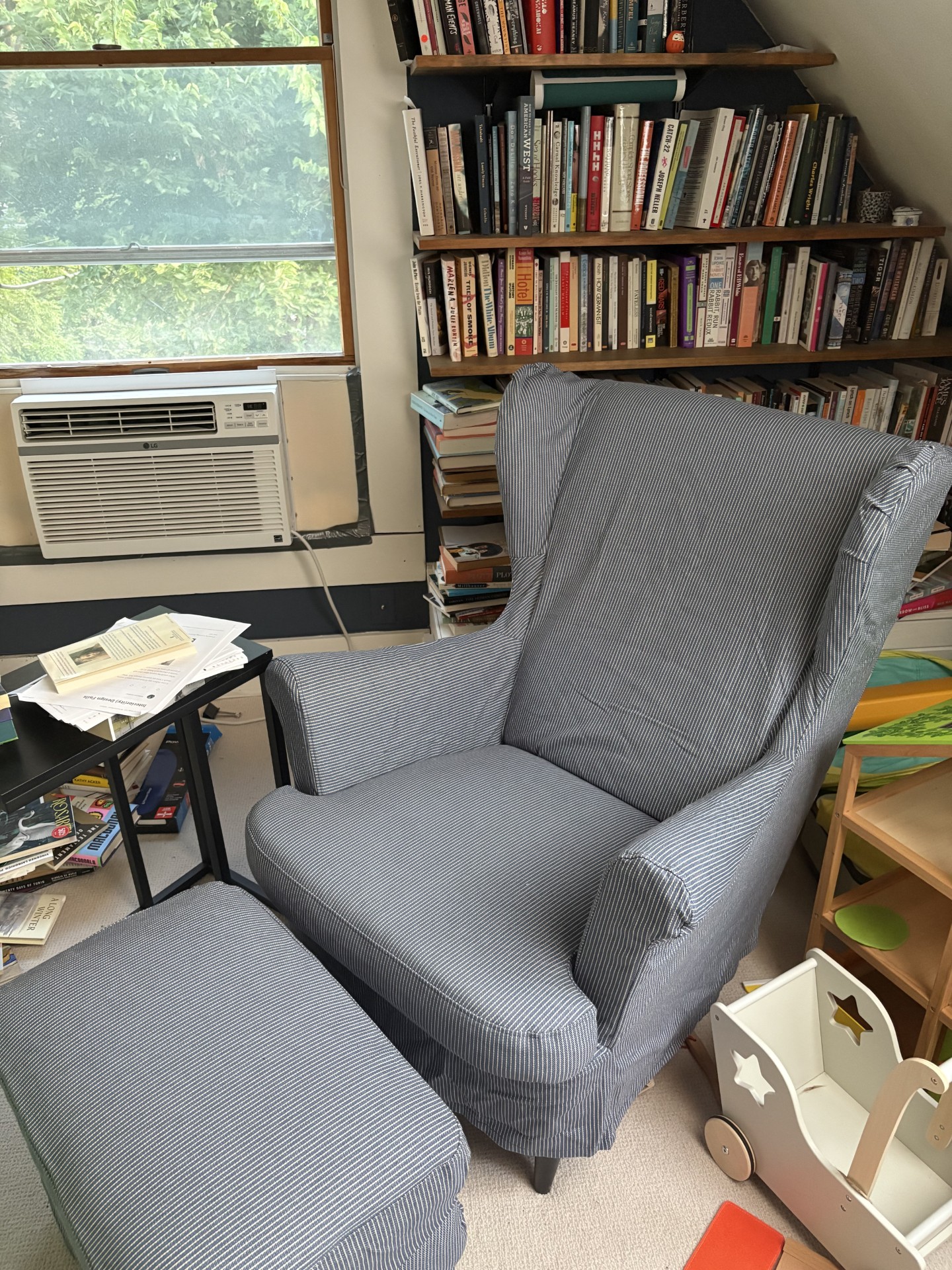
Julie Buntin: Though I have a dedicated writing space in the attic of my house, sort of—there’s a guest bed up there, and a bunch of books we still don’t have space for on the shelves, and the dollhouse my kids never play with, and several puzzles in various stages of completion, not to mention the dust and the strange assortment of fly carcasses that repopulate seemingly every couple of weeks—I will admit to writing there about as often as I write on my couch, or at the kitchen table, or in my flavorless fluorescent office on the University of Michigan’s campus.
I have felt, up there in the attic, door shut against my children, working on something very hard with as much of myself as I can muster, like I’m the very brain of the house—or maybe that the attic itself is the brain of the house and I’m a thought sparking in it.
Here is a picture of my chair in the aspirational writing attic that’s mainly a backup playroom/guest room, where I did actually write the closing line of my most recent novel. In a planned way. On a summer afternoon. I’d been working through a major revision, and the night before, at around one in the morning, my son snoring so loud, I could hear him from the living-room couch, I stopped myself just before adding the closing beat to the paragraph, even though I could feel it on the tip of my mind. The next day, I excused myself from parenting and headed upstairs. “I’m going to finish my book now,” I said to my family. And I sat down in my chair, and I did.
|
|
|
|
|